LAB 01 · Live workbench
Battery Tech & BMS
Explore lithium-ion battery configurations, series-parallel pack assembly, cell balancing, battery parameters, charging and discharging behaviour, and BMS protection concepts.
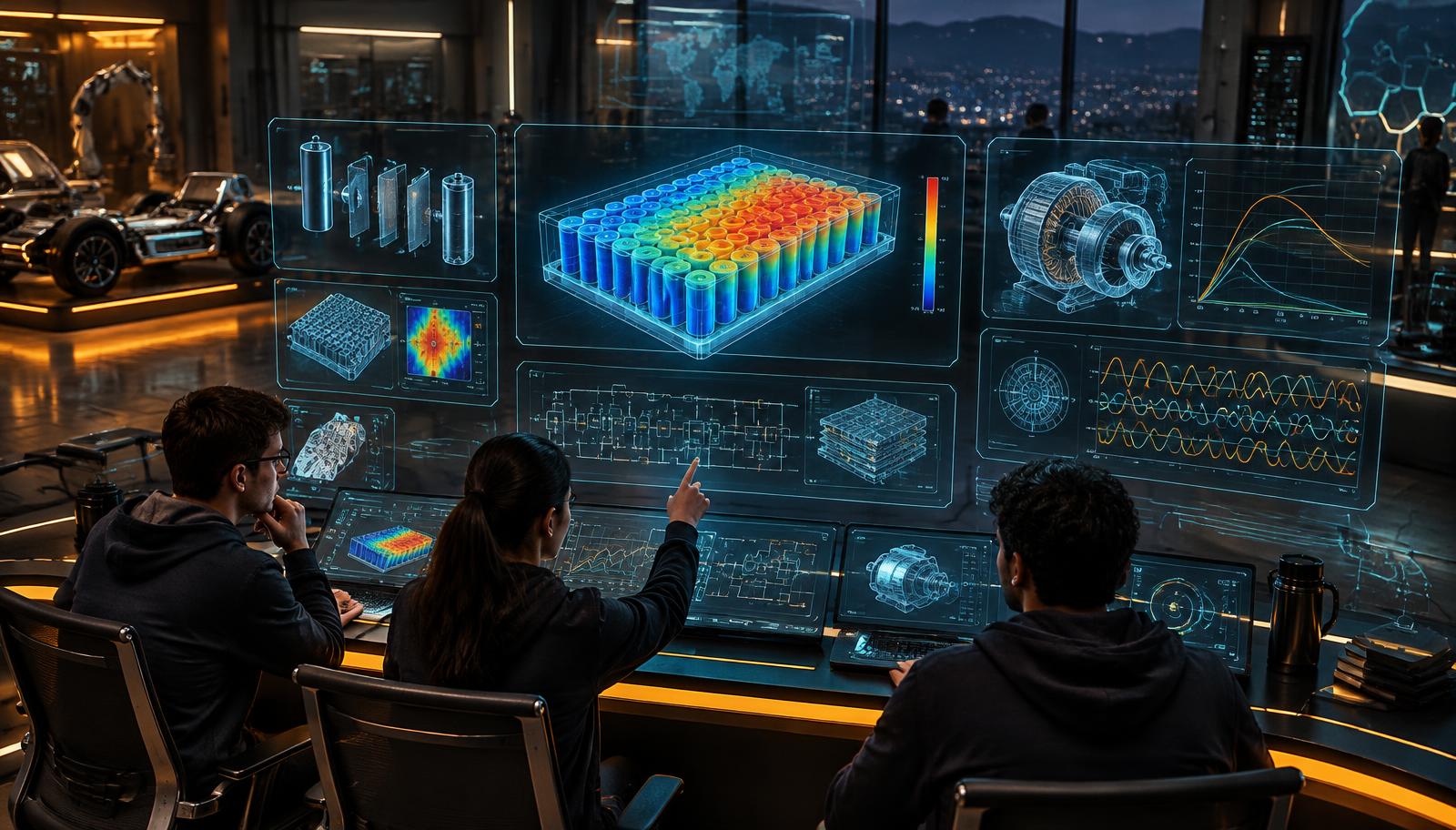
About Virtual EV Labs
Virtual EV Labs is an interactive virtual engineering laboratory platform designed to make engineering education more practical, accessible and application-oriented.
We bring together virtual experiments, engineering calculations, interactive simulations, system-level visualisations and technical learning resources to help students, educators and industry professionals understand how real engineering systems work.
From lithium-ion battery technology and Battery Management Systems (BMS) to electric vehicle powertrains, power electronics, EV charging systems, high-voltage safety, battery thermal management and automotive communication networks, Virtual EV Labs provides a connected environment for exploring the technologies shaping modern electric mobility.
Our objective is simple: help learners move beyond theoretical understanding and develop the engineering knowledge, analytical thinking and technical problem-solving skills required by the evolving automotive and electrical industries.
To become a leading digital platform for interactive engineering education, virtual experimentation and technology-driven skill development in electric mobility and core electrical engineering.
We envision a learning environment where engineering students can explore complex systems, perform experiments, analyse results and understand practical engineering applications regardless of their physical location.
To make engineering experimentation more accessible, engaging and application-oriented through technology-enabled virtual laboratories. We aim to:
What can you explore?
Virtual EV Labs brings eight major engineering domains together in one integrated learning environment. Each laboratory is designed around its own engineering domain, with relevant components, instruments, controls, simulation models and analytical outputs.
LAB 01 · Live workbench
Explore lithium-ion battery configurations, series-parallel pack assembly, cell balancing, battery parameters, charging and discharging behaviour, and BMS protection concepts.
LAB 02 · Live workbench
Understand electric vehicle powertrain systems, BLDC and PMSM motor characteristics, speed-torque relationships, motor performance and drive-system fundamentals.
LAB 03 · Live workbench
Explore DC-DC converters, buck and boost topologies, switching behaviour, continuous and discontinuous conduction modes, solar PV characteristics and MPPT concepts.
LAB 04 · Live workbench
Perform virtual experiments involving electrical circuits, Ohm's law, Kirchhoff's laws, Thevenin and Norton theorems, AC circuits and RLC resonance.
LAB 05 · Live workbench
Understand EV charging infrastructure, IEC 61851 concepts, Control Pilot and Proximity Pilot signals, EVSE operation and CCS2 charging communication sequences.
LAB 06 · Live workbench
Explore EV high-voltage architecture, pre-charge circuits, inrush current, contactor sequencing, insulation monitoring and ground fault detection concepts.
LAB 07 · Live workbench
Study battery heat generation, air cooling, liquid cooling, cold plate concepts, temperature distribution and battery thermal management strategies.
LAB 08 · Live workbench
Understand CAN communication, CAN frames, DBC decoding, vehicle control unit architecture, accelerator pedal plausibility and automotive fault diagnostics.
Our approach
We believe engineering should be explored, tested and understood through practical application.
01
Explore engineering fundamentals, system architecture, technical concepts and operating principles.
02
Select components, adjust parameters and configure engineering systems.
03
Interact with virtual workbenches and perform structured engineering experiments.
04
Observe system behaviour, study measurements, interpret graphs and perform engineering calculations.
05
Identify faults, compare results and develop technical problem-solving skills.
06
Record observations, review experiment results and generate structured virtual laboratory reports.
Virtual EV Labs provides an opportunity to explore engineering concepts beyond conventional classroom learning. Learners can access available virtual experiments, understand technical systems, perform simulations, analyse results and build a structured record of their learning progress. The platform is designed to complement academic study and practical laboratory exposure.
Virtual EV Labs supports engineering institutions looking to strengthen their laboratory-based learning ecosystem, across Electrical, Electronics and Communication, Mechanical, Mechatronics, Automobile Engineering and related programmes.
Institutional solutionsA technology-oriented learning environment for automotive and electric mobility professionals — battery technology and BMS, motor drives, EV power electronics, charging systems, high-voltage safety, thermal management, CAN communication and vehicle control systems.
Corporate trainingTechnology
Virtual EV Labs is being developed around interactive engineering workspaces that combine:
Different laboratories use different simulation approaches depending on the engineering problem, including electrical circuit models, system-level calculations, protocol visualisations and thermal models.
The platform clearly distinguishes educational simulation from physical laboratory measurements and hardware-connected testing.
Our commitment
We are committed to building an engineering learning environment that values technical accuracy, meaningful experimentation, accessible education and continuous improvement. Our goal is not simply to provide digital versions of laboratory manuals. It is to help learners understand engineering systems, investigate their behaviour and develop the confidence to solve real-world technical problems.
Discover a new way to learn electric vehicle technology and core electrical engineering. Explore the laboratories, perform experiments, analyse engineering systems and build practical understanding.
Virtual EV Labs — developed by EVGURU
Explore the laboratories